|
|

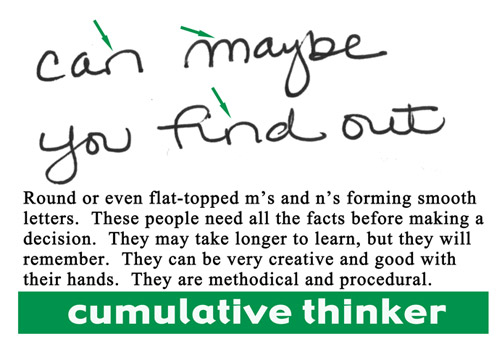
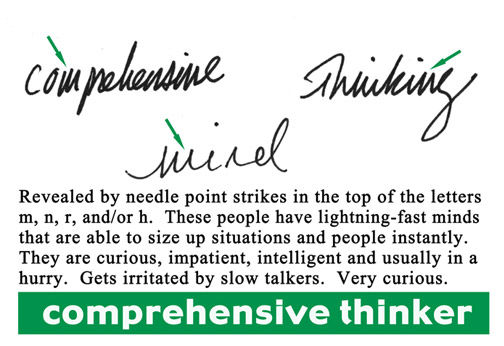
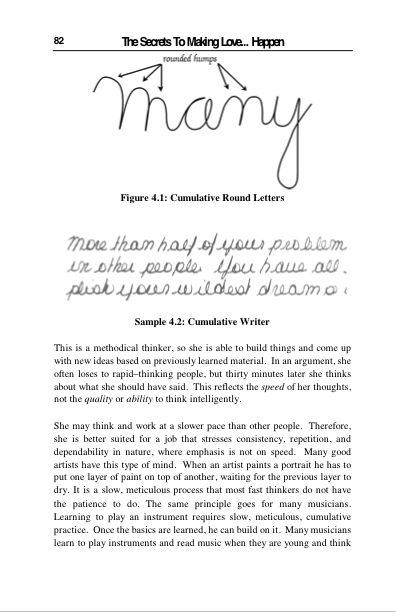
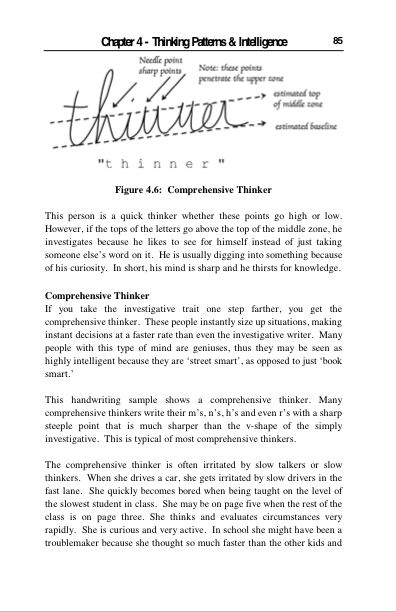
One of the most common reasons why people want to use handwriting analysis in their life is they want to know how intelligent somebody is, how ethical they are and they want to know how compatible they would be in a romantic or business situation. Our more in-depth courses discuss three basic groups of thinking patterns: Cumulative, Investigative, and Comprehensive. Then we will look at some variations of these three basic patterns. The thinking patterns are shown in the middle zone letters m, n, h, and even r. However, most of your information will come from the two lower case letters m and n. You will be looking at the way the upper humps are formed: curved, pointed, or retraced. You also will be looking at the way the downstrokes are formed: v-shape, looped, retraced, etc. In each of these strokes, you will be able to determine a different aspect of the person’s method of thinking. Just observe the strokes of the letter to determine the pattern. The process leaves the probing investigative student totally bored out of his mind, because he has to wait on the slowest student in class. In many cases, the child with the greatest natural ability to synthesize information and think creatively is stuck in a system designed for students to only achieve minimal requirements. You already know intelligence has absolutely nothing to do with getting high grades in school. Getting great grades involves such factors as motivation, attitude, interest, and self-discipline. The cases of learning difficulties are usually a matter of instructors teaching ineffective thinking and learning strategies. If teachers could present information in a style appropriate and conducive to each individual student’s learning patterns, we wouldn’t have so many delinquent students. Learn about your own thinking pattern and learn within that style. If you have a cumulative style, take one step at a time; on the other hand, if you are super-exploratory; jump into the middle and gather all of the facts as fast as you can in any particular order. She likes to have all the facts before making a decision. She thinks or creates much like a mason, stacking fact upon fact. Her thought pattern, the conclusion, will not be complete until the last fact is in place. This writer learns faster through demonstration than through written or verbal directions. She also learns easier through experiencing it herself, rather than by observing someone else doing it. Once she has learned ’t forget it. Handwriting Clues This is a methodical thinker, so she is able to build things and come up with new ideas based on previously learned material. In an argument, she often loses to rapid–thinking people, but thirty minutes later she thinks about what she should have said. This reflects the speed of her thoughts, A comprehensive thinker has sharp, pointy m's and n's. They are fast thinkers and fast talkers. They don't always take time to dig deeply, unless necessary. They will make a fast decision and get bored quickly. The comprehensive thinker is often irritated by slow talkers or slow thinkers. When she drives a car, she gets irritated by slow drivers in the fast lane. She quickly becomes bored when being taught on the level of the slowest student in class. She may be on page five when the rest of the class is on page three. She thinks and evaluates circumstances very rapidly. She is curious and very active. In school she might have been a troublemaker because she thought so much faster than the other kids and she finished her work first, thus having plenty of time on her hands to make trouble! The concept if intelligence is covered in much more depth, which includes combining other letters and formatins in addition to the m's and n's. This is "advanced trait stacking" which is discussed in the level 5 home study course. http://myhandwriting.com/order/catalog.html (click here to view higher level courses)
These pages are reprinted here with permission from the 304 page book Handwriting Analysis for Love, Sex, and Relationships by Bart Baggett. Available online and worldwide.
Bonus Materials and Suggested Programs
©2007 by Bart A. Baggett & Handwriting University International All Rights Reserved |
||||||||||||||||||||||||||||||||||